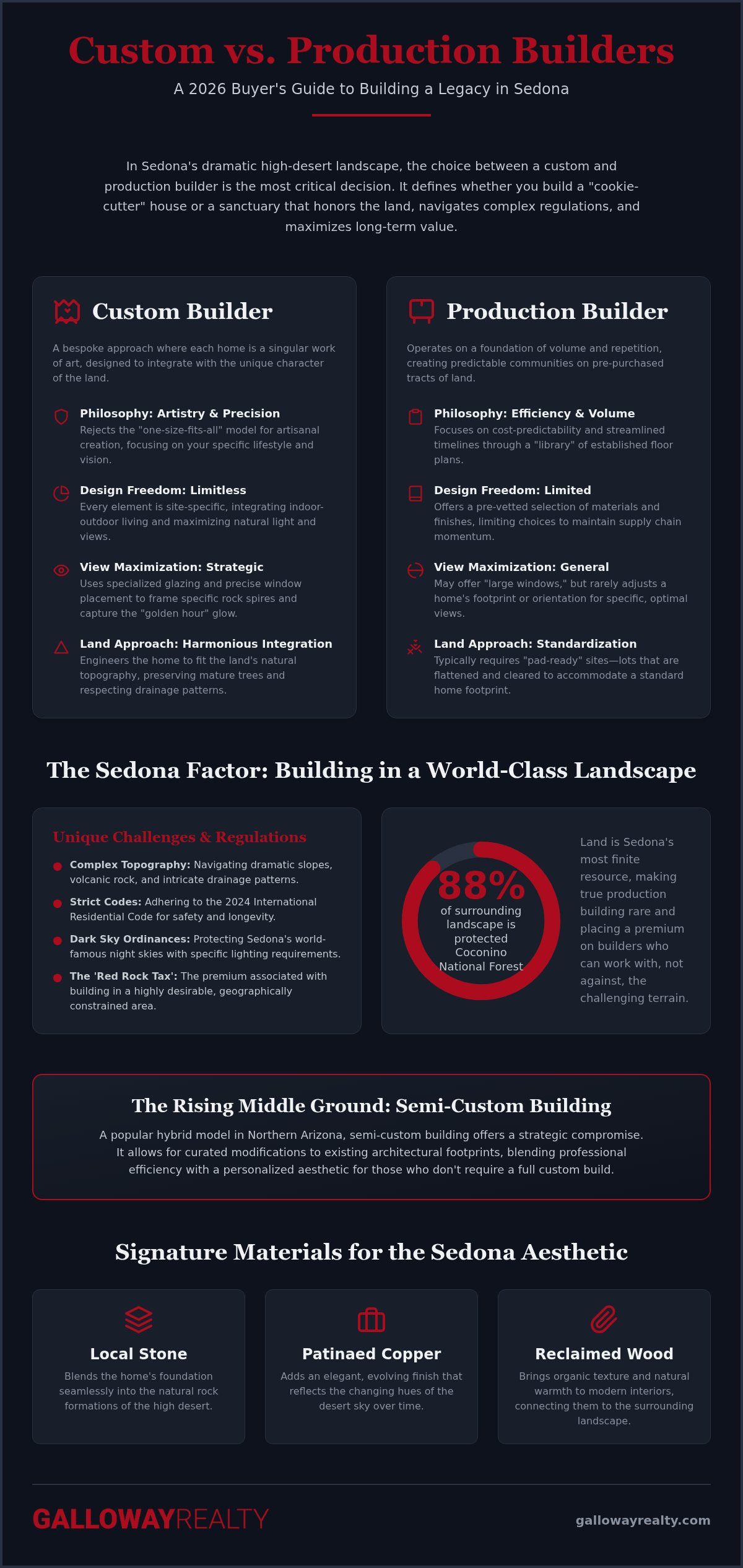
Choosing a floor plan from a catalog might seem efficient, but in the vertical drama of the high desert, a pre-designed home often works against the very land it occupies. The choice between a custom home builder vs production builder Sedona is the most consequential decision in your journey toward a high-desert legacy. You likely want a sanctuary that honors this world-class landscape without falling into the "cookie-cutter" trap or getting buried in technical regulatory delays. It's a natural concern for those looking to plant roots among the crimson spires.
This 2026 guide reveals the critical distinctions between these two paths so you can determine which one leads to your ideal sanctuary. We will explore the financial commitments of each approach, the nuances of navigating the 2024 International Residential Code, and the reality of building on our region's difficult terrain. You'll gain the confidence to choose a partner who understands the "Red Rock Tax" and knows how to maximize your views while protecting your long-term resale value.
Defining the Choice: Custom vs. Production Builders in Sedona
The decision between a custom home builder vs production builder Sedona represents a fundamental choice between two distinct philosophies of habitation. Production builders operate on a foundation of volume and repetition. They utilize pre-purchased tracts of land to create predictable, organized communities. Conversely, custom builders approach each project as a singular work of artistry. This path requires a deep understanding of the land and a commitment to individual expression that transcends mass-market standards.
Understanding different types of home construction is essential for navigating the local market effectively. In 2026, the "middle ground" of semi-custom building has surged in popularity among Northern Arizona buyers. This model allows for curated modifications to existing architectural footprints. It provides a strategic compromise for those who value both professional efficiency and a personalized aesthetic without the longer timelines of a full custom build.
To better understand the precision involved in modern construction methods, watch this look at advanced production lines:
The Production Builder Model in Northern Arizona
True production building is rare in Sedona because land is a finite resource. Approximately 88% of our surrounding landscape is Coconino National Forest. This scarcity forces a focus on extreme efficiency. Production-style builders offer cost-predictability through a "library" of established floor plans. They maintain supply chain momentum by limiting material choices to a premium, pre-vetted selection. This approach is ideal for buyers seeking a streamlined transition into a community with existing infrastructure and predictable timelines.
The Custom Builder Philosophy
The custom path begins with your specific lifestyle and a unique piece of Sedona earth. This philosophy rejects the "one-size-fits-all" mentality in favor of artisanal precision. Every design choice integrates with the lot's specific topography and view corridors. You have the freedom to navigate the technical and regulatory maze with a specialized custom home builder who understands Dark Sky ordinances and the 2024 International Residential Code. It's a bespoke creation process that ensures your home is a legacy, not just a transaction.
Design Freedom and the 'Sedona Aesthetic'
Sedona's landscape isn't a backdrop; it's the primary architectural driver. Traditional "cookie-cutter" designs fail here because they treat every lot as a flat, featureless rectangle. When evaluating a custom home builder vs production builder Sedona, the difference lies in how a structure responds to the light. A production model often forces a suburban silhouette onto a world-class landscape, resulting in missed opportunities and aesthetic friction.
High-desert architecture requires a site-specific approach. Production builders prioritize speed, which means they rarely adjust a home's footprint to save a mature juniper or align a kitchen window with Cathedral Rock. Custom builds prioritize the land, integrating indoor-outdoor living spaces that respond to 2026 climate trends. These designs utilize natural thermal chimneys and deep architectural overhangs to maintain comfort without sacrificing the connection to the outdoors.
Maximizing Red Rock Views
A custom placement turns a standard view into a breathtaking experience. While production homes might offer "large windows," a custom builder uses specialized glazing and strategic window placement to frame specific spires. They consider the sun's path to prevent glare while ensuring the Red Rocks glow during the golden hour. You can use Sedona red rock view homes as a design benchmark to see how professional orientation elevates the living experience. This level of precision is simply not possible with a catalog-based floor plan.
Materiality and Local Character
The distinction between a custom home builder vs production builder Sedona is most apparent in the choice of materials. Luxury in the high desert is defined by harmony, not just scale. Many production models rely on standard stucco and generic finishes that can feel out of place against the rugged terrain. Custom builds move beyond these basics, incorporating:
- Local Stone: Blending the foundation into the natural rock formations.
- Patinaed Copper: Reflecting the changing hues of the desert sky.
- Reclaimed Wood: Adding warmth and organic texture to modern interiors.
This artisanal approach avoids the "suburban" look that plagues mass-market developments. It ensures your home maintains aesthetic harmony with the desert's timeless character. If you are ready to explore how these elements can define your future sanctuary, you may want to consult with a local specialist for a detailed vision session.
Site Selection: Navigating Sedona’s Complex Topography
Building in the high desert is an exercise in geological negotiation. The terrain here is characterized by dramatic slopes, intricate drainage patterns, and stubborn volcanic rock. When you weigh the merits of a custom home builder vs production builder Sedona, the site itself often dictates the choice. Production builders typically require 'pad-ready' sites. These are lots that have been flattened and cleared to accommodate a standard footprint. In Sedona, finding such a site in a premium location is increasingly rare.
A custom builder approaches the land with a different set of priorities. They engineer the home to fit the topography rather than forcing the topography to fit the home. This distinction is why luxury home site selection in Sedona serves as the most critical first step for any serious investor. It's the point where your vision either harmonizes with the earth or struggles against it.
Engineering for Slopes and Scenery
Forcing a production floor plan onto a sloped lot creates hidden costs that can quickly derail a budget. You might spend six figures on massive retaining walls and extensive fill dirt just to make a standard plan viable. A custom foundation works with the natural grade. It utilizes pier-and-beam structures or stepped levels to minimize excavation. This approach preserves the natural drainage and mitigates erosion. It protects the delicate high-desert ecosystem while often saving money on earthwork that adds no aesthetic value to the home.
Regulatory Mastery: HOAs and City Codes
The technical and regulatory maze in Coconino and Yavapai counties is exceptionally dense. It requires a builder who understands the nuances of 'Dark Sky' lighting ordinances and the 2024 International Residential Code. Most Sedona neighborhoods feature strict HOA architectural reviews. These committees ensure that new construction doesn't disrupt the community's aesthetic soul. A specialized builder maintains established relationships with local officials. They ensure your design passes scrutiny without losing its architectural character. This mastery is essential for navigating the 2024 International Fire Code updates, which became effective on May 1, 2026, and require fire suppression systems for new builds.