
In the red rock country of Sedona, a building permit is more than a legal requirement; it's an environmental and aesthetic commitment to one of the world’s most protected landscapes. Successfully navigating the Sedona home building permit process requires more than just submitting paperwork. It demands a sophisticated understanding of the city’s evolving standards, including the mandatory transition to the 2024 International Building Code. You’re likely concerned that strict local codes or unforeseen environmental restrictions could lead to a 20-week delay or costly revisions. We understand that uncertainty is the greatest enemy of a luxury build. This guide provides an expert-led roadmap to mastering Sedona’s 2026 regulations with absolute confidence. You'll discover the precise timeline for approval, a definitive checklist of required documents, and the specific fire district fee structures that will define your project’s initial phase. From the nuances of the Unified Permit Process to the city's restrictive color requirements, we've distilled the complexities into a streamlined path forward for your next custom creation.
Understanding the Sedona Building Permit Landscape
The Sedona Community Development Department serves as the rigorous gatekeeper of the city’s architectural integrity. While neighboring Yavapai or Coconino counties might offer more lenient oversight, Sedona maintains a unified, city-specific standard. This ensures that every project, whether a custom estate or a boutique renovation, honors the natural beauty of the Red Rock region. The city acts with a sense of stewardship, viewing every structure as a permanent addition to a world-class landscape.
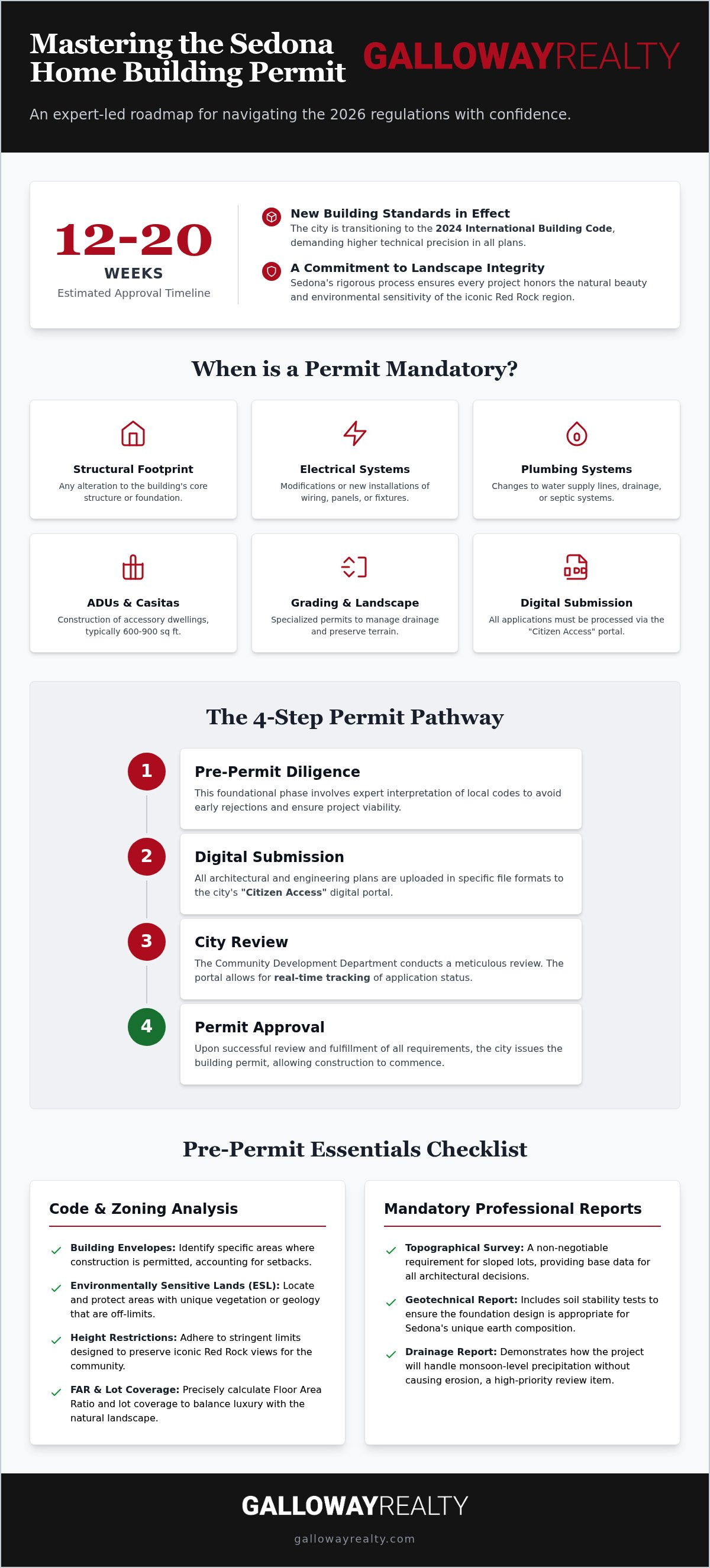
Securing a building permit in this jurisdiction is a specialized endeavor. The city is currently transitioning from the 2018 standards to the 2024 International Building Code; this move demands technical precision from your design team. For those initiating the Sedona home building permit process in 2026, expect a total timeline ranging from 12 to 20 weeks. This duration accounts for the meticulous reviews required to maintain the city's unmatched aesthetic and safety standards.
To better understand the fundamentals of this journey, watch this helpful video regarding the general steps of construction approval:
Excellence in development requires foresight and a mastery of local nuances. Whether you are breaking ground on a custom home at Sky Ridge Estates or modernizing a legacy property, understanding the scope of municipal oversight is the first step toward a successful build. Our integrated approach ensures that every regulation is met with artisanal precision rather than mere compliance.
When a Permit is Mandatory
Not every modification requires city hall’s signature, but the threshold for substantial improvement is lower than many realize. Any renovation that alters the structural footprint, electrical systems, or plumbing requires formal approval. This includes the creation of accessory dwelling units (ADUs) or casitas, which typically range from 600 to 900 square feet in the local market. Sedona’s unique topography also necessitates specialized grading and landscape permits. These are essential to manage drainage and preserve the fragile desert terrain during the construction of a custom home build.
The 2026 Digital Submission Portal
Efficiency is the hallmark of a modern build. The City of Sedona requires all applications to be processed through the "Citizen Access" digital portal. This system standardizes the Sedona home building permit process by requiring specific file formats for all architectural and engineering plans. Once your team uploads the documentation, the portal allows for real-time tracking of the application status. This digital transparency reduces uncertainty and ensures that every stakeholder remains informed throughout the review cycle, moving your project from inquiry to action with professional momentum.
Pre-Permit Essentials: Preparing Your Project for Success
Success in the Sedona home building permit process begins long before you log into a digital portal. The city’s Land Development Code (LDC) is a dense, sophisticated document that requires expert interpretation to avoid early rejections. Unlike generic municipal codes, Sedona's LDC protects the visual and ecological sanctity of the desert. Identifying your property's specific constraints early ensures your vision remains viable through the review phase. It's the difference between a project that moves and one that stalls.
Evaluating your lot against the LDC involves identifying "Building Envelopes." These are the specific areas where construction is permitted after accounting for setbacks and protected zones. For those with significant acreage, identifying "Environmentally Sensitive Lands" (ESL) is critical. ESL areas may contain protected vegetation or unique geological features that are legally off-limits for development. A topographical survey is non-negotiable for Sedona’s signature sloped lots. It provides the base data for every architectural decision and ensures your home sits naturally within the terrain.
Zoning and the Land Development Code
Zoning designations like R1 or RS dictate more than just density; they define the physical limits of your buildable area. Height restrictions are particularly stringent in this region. The city enforces these rules to preserve the iconic Red Rock views for the entire community. You must also calculate the Floor Area Ratio (FAR) and lot coverage limits with precision. These metrics ensure that your home balances luxury with the natural landscape, preventing the over-building seen in less regulated markets. This level of detail is what separates a premium development from a standard house.
Geotechnical and Drainage Reports
The high desert terrain presents unique engineering challenges. Soil stability tests are essential to ensure your foundation can withstand the specific composition of Sedona’s earth. Managing stormwater runoff is another primary concern for the Community Development Department. You must submit drainage reports that demonstrate how your project handles monsoon-level precipitation without eroding the hillside or impacting neighboring properties. Erosion control is a high-priority review item for hillside properties where the stakes are highest.
Preparation is the foundation of a seamless build. While you can find the Official Sedona Permit Applications online, translating those requirements into a buildable plan requires specialized knowledge. Aligning your project with these standards from the outset saves months of back-and-forth with city planners. If you're ready to evaluate a potential site or refine your architectural plans, consult with our specialized team to ensure your project begins on solid ground.
Navigating the Application and Review Phases
The Sedona home building permit process transitions from vision to technical reality during the formal application phase. This is a high-stakes progression where technical precision is the only acceptable standard. Your journey begins with a comprehensive Building Permit Application, a document that establishes the legal and structural parameters of your project. Following this, your design team must submit a sophisticated suite of architectural, structural, and MEP (Mechanical, Electrical, Plumbing) plans. These documents must now reflect the city’s adoption of the 2024 International Building Code, a change that requires updated engineering and safety protocols.
Once your documentation is submitted, Sedona's Community Development Department initiates a Completeness Review. This is a preliminary gatekeeping phase designed to ensure your application package contains every necessary component for a deep-dive technical audit. If the package passes, it moves into the plan-check stage. Here, managing comments and corrections becomes the primary focus. City plan checkers will provide "redlines" or specific technical feedback that your architects and engineers must address. Responding to these critiques with speed and accuracy is essential to maintaining your project's timeline and avoiding unnecessary delays.
Required Documentation for 2026
A successful submission in 2026 requires more than just a site plan and floor plans. Your documentation must include precise elevations that respect the city's view-shed requirements. You must also demonstrate strict energy conservation compliance, adhering to the latest IECC 2021 or 2024 standards. Given Sedona's arid climate, adherence to the Wildland-Urban Interface (WUI) code is mandatory. This includes specific requirements for fire-resistant materials and defensible space, ensuring your custom home build is as resilient as it is beautiful. Key submission items include:
- Class A Roofing: Non-combustible materials designed for high-fire-risk zones.
- Defensible Space: A landscape plan that manages fuel loads around the structure.
- Ignition-Resistant Materials: Specific requirements for siding and decking.
The Multi-Departmental Review
Your application is reviewed by a specialized collective of experts from the Planning, Engineering, and Fire departments. These professionals collaborate to ensure your project aligns with the Land Development Code and public safety mandates. Simultaneously, the Water and Wastewater departments verify that your new residence integrates seamlessly with existing municipal infrastructure. This thorough, multi-layered review process is why you should anticipate a timeline of 12 to 20 weeks for full approval. Our expertise in managing these departmental expectations allows us to navigate this complexity with a sense of polished reliability, moving your project from a state of inquiry to a state of action.
Overcoming Sedona’s Unique Regulatory Challenges
A permit in Sedona is a commitment to the region's ecological legacy. The Sedona home building permit process is deeply intertwined with environmental preservation, extending far beyond the structural integrity of the home. One of the most critical early hurdles is the native plant salvage requirement. Before any excavation begins, the city requires a detailed plan to identify, tag, and protect specific flora such as Agave, Ocotillo, and Juniper. This isn't merely about aesthetics; it's a legal mandate to preserve the high desert's biodiversity. Successfully managing this salvage process ensures your project maintains its momentum without facing environmental citations.
For properties in specific zones, the Design Review Board (DRB) adds an additional layer of professional scrutiny. They evaluate the "massing" and "context" of your structure to ensure it doesn't overwhelm the natural red rock backdrop. This high-level oversight is what keeps Sedona's real estate values among the most resilient in the Southwest. It requires a design team that views building as an art form rather than a simple transaction.
Dark Sky Ordinances and Exterior Lighting
Sedona is a premier International Dark Sky Community. This designation is protected by strictly enforced ordinances that dictate every aspect of your property’s nighttime profile. Every exterior fixture on your custom home build must be fully shielded to prevent light trespass into the atmosphere. The city also implements rigid lumen caps and color temperature requirements. Outdoor lighting must generally stay below 3000 Kelvin to minimize blue light pollution. We specialize in balancing these astronomical preservation rules with the need for sophisticated security and architectural highlighting. It's about achieving a glow that feels premium without violating the sanctity of the stars.
HOA vs. City Requirements
Navigating the Sedona home building permit process often requires a dual-track strategy for approval. Most luxury developments, including Sky Ridge Estates, have their own Architectural Control Committees (ACC). The city typically requires an official HOA approval letter as a prerequisite for issuing your building permit. Conflicts often arise when city code permits a certain material that your community's CC&Rs prohibit. Resolving these discrepancies before submission is vital. We act as the authoritative bridge between these entities, ensuring your design meets the city's safety codes while satisfying the neighborhood’s exclusive aesthetic guidelines.
If you're feeling overwhelmed by these layered regulations, we provide the specialized expertise to clear every hurdle with ease. Contact our team today to secure a partner who understands the art of Sedona development and the nuances of the local landscape.
Streamlining Your Build with a Local Expert
Mastering the Sedona home building permit process is not a solo endeavor. It requires a partner who lives and breathes the local code. Partnering with a specialized custom home builder provides more than just construction; it offers a strategic advantage in a highly regulated market. We understand the nuances of the 2024 International Building Code and how city officials interpret them. Early consultation can eliminate the 12 to 20 week delays often seen by those attempting to manage the process independently. We leverage established relationships with municipal departments and elite subcontractors to ensure your project remains a priority throughout the review cycle.
For those seeking a streamlined path to a luxury residence, we offer permit-ready opportunities at Sky Ridge Estates. These exclusive lots have already undergone rigorous vetting for topography and environmental constraints. Choosing a pre-vetted site allows you to bypass the initial uncertainty of raw land development. It moves you directly into the creation phase with a sense of polished reliability and confidence.
The Benefit of an Integrated Approach
Our integrated broker-builder model is the gold standard for luxury development in the Red Rocks. We identify land that is truly buildable before you commit to a transaction. This proactive vetting uncovers hidden permit hurdles like drainage complexities or native plant salvage requirements that often surprise outside investors. By aligning the real estate purchase with the building strategy, we reduce your financial risk and accelerate your timeline. You can read more in our guide on building a custom home in Sedona to understand the full lifecycle of a Red Rock sanctuary.
Your Next Steps in the Sedona Market
Success begins with a pre-design consultation. This session aligns your architectural vision with the reality of Sedona’s Land Development Code. It's essential to verify that your team includes an "ROC" licensed contractor to ensure your investment is protected under Arizona law. We provide a bridge between your visionary goals and the technical requirements of the Sedona home building permit process. Once approval is secured, the transition from paperwork to the first shovel in the ground is seamless. We lead the pack by turning complex regulations into a logical, step-by-step progression toward your custom home. Contact us today to begin your journey with Sedona's authoritative experts.
Realize Your Vision in the Red Rocks
Mastering the Sedona home building permit process is the final hurdle between an inspired architectural concept and a physical masterpiece. This journey requires more than just technical compliance; it demands a deep respect for the city's unique environmental and aesthetic standards. You've learned how to navigate the Land Development Code, manage multi-departmental reviews, and align your project with stringent Dark Sky ordinances. These steps ensure that every new structure honors the legacy of the landscape it inhabits.
Success in this market is defined by foresight and specialized knowledge. Our firm brings a dominant presence to the industry, backed by a legacy of over 2,000 homes sold and exclusive access to premium developments like Sky Ridge Estates . We don't just facilitate transactions; we master the art of creation by vetting every lot and streamlining every permit hurdle. Our unmatched expertise in Sedona's Land Development Code allows you to move forward with absolute confidence and polished reliability.
Contact Galloway Realty to Simplify Your Sedona Build. We are ready to provide the elite professionalism and local expertise required to turn your custom home dreams into a reality. Your Red Rock sanctuary is within reach.
Frequently Asked Questions
How long does it take to get a building permit in Sedona in 2026?
The Sedona home building permit process typically requires a timeline of 12 to 20 weeks. This duration depends heavily on the complexity of your custom build and the number of review cycles required by city departments. Submitting high-quality, technically precise plans on your first attempt is the most effective way to expedite this schedule and avoid unnecessary delays during the plan-check phase.
What is the cost of a building permit in Sedona?
Permit fees are calculated based on the total project valuation and the square footage of the structure. These costs generally encompass plan check fees, building permit fees, and significant development impact fees for public infrastructure like parks and transportation. Because these variables are project-specific, a detailed fee assessment should be part of your initial financial planning for any luxury residence.
Do I need a permit for a minor remodel in Sedona?
Most interior remodels that involve structural alterations, electrical updates, or plumbing changes require a formal building permit. While purely cosmetic enhancements like interior paint or new flooring are usually exempt, any modification affecting the home's core systems must be vetted by the city. We recommend a preliminary consultation with the Community Development Department to confirm your project's specific requirements before starting work.
What is the Sedona Land Development Code (LDC)?
The Land Development Code (LDC) is the primary set of regulations governing zoning, land use, and development standards within city limits. It serves as the legal framework ensuring that all new construction aligns with the community's vision for preserving the natural environment. Navigating the LDC with specialized expertise is essential to securing approval for high-end residential projects in the Sedona home building permit process.
Are there specific color requirements for homes in Sedona?
Sedona enforces strict Light Reflective Value (LRV) standards and specific color palettes for all exterior surfaces. Homeowners must select earth-toned hues that blend seamlessly with the natural Red Rock environment to minimize visual impact. These requirements are meticulously reviewed by city staff to maintain the unmatched aesthetic harmony that defines this world-class destination and protects local property values.
Can I act as my own owner-builder in Sedona?
While Arizona law permits you to act as an owner-builder, it is highly discouraged for complex luxury projects in this jurisdiction. The technical demands of local building codes and the liability involved in managing specialized subcontractors require a professional level of oversight. Partnering with a licensed expert ensures your investment is protected and your vision is executed with the artisanal precision expected in the Sedona market.
