
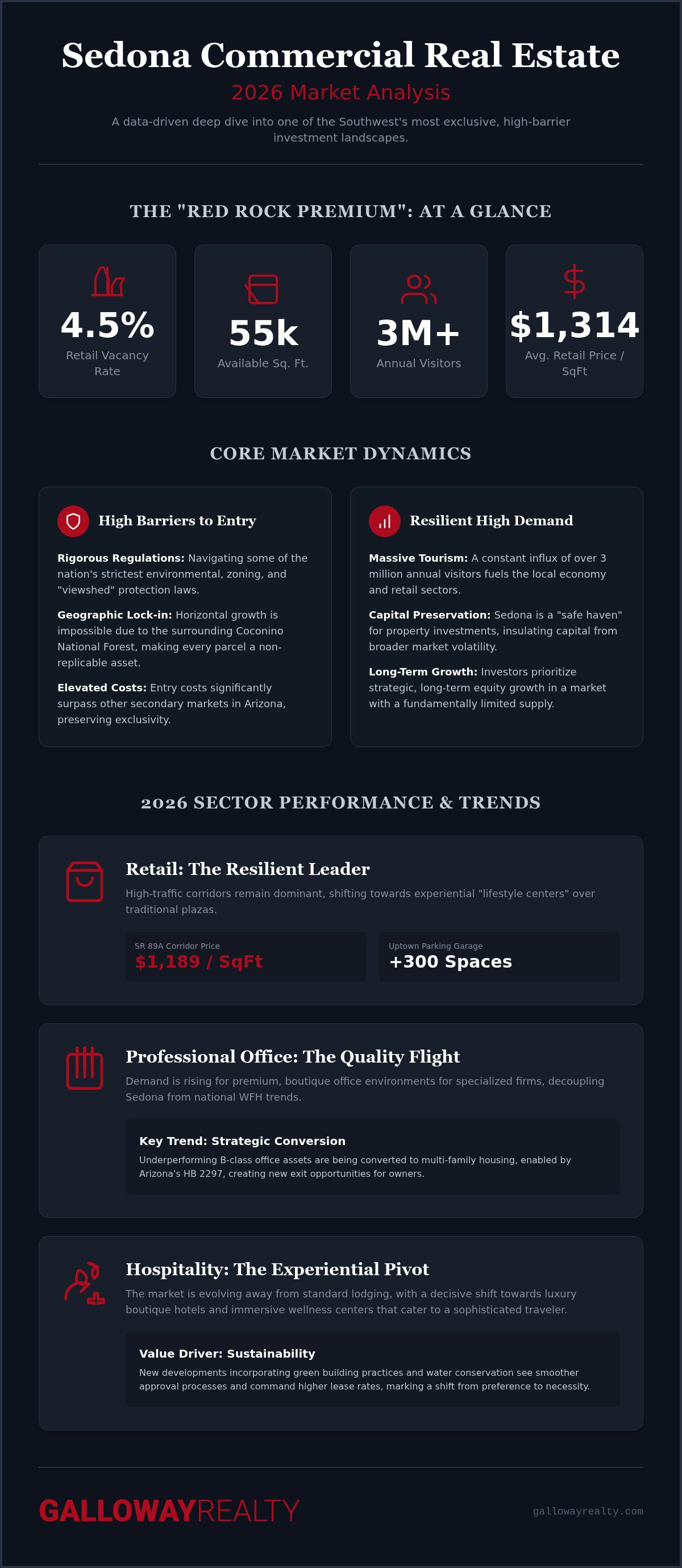
With retail vacancy rates at a razor-thin 4.5% and total available inventory restricted to a mere 55,652 square feet, the 2026 landscape is defined by enforced scarcity. You've likely realized that securing a position in this market requires navigating some of the most rigorous environmental and zoning restrictions in the country. It's a high-barrier environment where entry costs often dwarf other Arizona secondary markets; however, the rewards for those who successfully penetrate the "Red Rock" curtain are unmatched. This Sedona commercial real estate market analysis provides the elite, data-driven clarity required to identify premium investment yields within our specialized regulatory framework.
We'll explore why retail sectors are commanding $1,314 per square foot and how the 2026 completion of the Uptown parking garage is recalibrating local property values. You'll gain a sophisticated understanding of current economic trends, from the shift toward experiential boutique hotels to the impact of the 2024 International Building Code. We'll preview the strategic advantages of a partner who masters both the brokerage and development phases, ensuring your investment is built on a foundation of local expertise and artisanal precision. This is your roadmap to mastering one of the most exclusive commercial sectors in the Southwest.
The 2026 Sedona Commercial Real Estate Landscape
Sedona's commercial sector operates as a closed system where high demand perpetually collides with a finite, non-negotiable supply. This scarcity creates the "Red Rock Premium," a valuation phenomenon where property prices reflect not just square footage, but the inherent prestige of the landscape. As outlined in this Sedona, Arizona overview, the region's geography is as much an economic driver as its tourism. Investors don't just buy buildings here; they acquire positions in a protected ecosystem that effectively insulates capital against broader market volatility.
Liquidity in 2026 remains resilient despite an Arizona commercial mortgage environment starting around 6.77%. While higher rates have slowed activity in Phoenix, Sedona remains a safe haven for property investments due to its unique "capital preservation" status. Serious investors prioritize the long-term equity growth found in a market with over 3 million annual visitors, viewing current entry points as strategic holds rather than speculative plays. This Sedona commercial real estate market analysis confirms that the floor for local property values is set by the city's inability to expand outward.
To better understand the nuances of this unique market, watch this helpful video:
Macro Trends Shaping the 2026 Market
The evolution of consumer behavior has triggered a decisive shift toward experiential retail and boutique hospitality. Traditional gift shops are being replaced by high-end wellness centers and immersive commercial spaces that cater to a more sophisticated traveler. Additionally, the rise of the "lifestyle" office in West Sedona reflects a growing demand for premium, small-scale workspaces designed for remote executives and local professionals. Sustainability has also transitioned from a preference to a value driver. New developments that integrate "green" building practices and water conservation enjoy smoother paths through the public hearing process and command higher lease rates.
Geographic and Regulatory Supply Constraints
Horizontal growth is physically impossible in Sedona because the Coconino National Forest serves as a permanent boundary. This Sedona commercial real estate market analysis highlights that every commercially zoned parcel is a legacy asset that cannot be replicated. The City of Sedona's 2026 priorities, specifically housing and economic diversification, place further pressure on existing commercial inventory. Strict mandates for architectural harmony and "viewshed" protections ensure that while development is difficult, the resulting assets possess an exclusivity that generic markets can't match. This regulatory friction isn't a hurdle; it's a safeguard for your investment's future value.
Sector Analysis: Retail, Office, and Hospitality Performance
A rigorous Sedona commercial real estate market analysis reveals a market where retail continues to dominate the performance landscape. In the 2026 fiscal year, the "winners" are those holding assets in high-traffic corridors where tourism demand is constant. Retail properties currently command an average price of $1,314 per square foot, a figure driven by the sheer volume of over 3 million annual visitors. While hospitality remains the engine of the local economy, the way visitors interact with "Main Street" is changing. We're seeing a decisive pivot from traditional souvenir shops toward high-end experiential spaces and boutique services that mirror the luxury residential growth in the area.
Retail: The Resilience of High-Traffic Corridors
Uptown and West Sedona represent two distinct but equally vital retail ecosystems. In Uptown Sedona, the 2026 completion of the new parking structure has added nearly 300 spaces, immediately boosting the viability of high-density retail. Vacancy rates for properties with State Route 89A frontage remain exceptionally low at roughly 4.5%. Investors are increasingly favoring "lifestyle centers" over traditional plazas. These developments prioritize aesthetics and pedestrian flow, aligning with the Sedona Community Plan which emphasizes architectural harmony and the preservation of the city's unique character. Properties along the 89A corridor now see average asking prices of $1,189 per square foot, reflecting their status as trophy assets.
Professional Office Space: The Quality Flight
Sedona's office market is effectively decoupled from national "work-from-home" trends. We see a "flight to quality" where local service providers, including specialized medical and legal firms, compete for limited Class A space in West Sedona. There's a rising demand for high-end, boutique office environments that cater to the city's affluent resident base. Older office stock is not sitting idle; instead, we're seeing a trend toward conversion. Under Arizona's HB 2297, some commercial buildings can now be converted into multi-family housing without an exhaustive rezoning process. This legislation provides a strategic exit or repositioning opportunity for owners of underperforming B-class office assets.
Hospitality-adjacent real estate is also evolving. The market is moving away from standard lodging toward boutique hotels and wellness centers that offer a deeper connection to the Red Rocks. If you're looking to capitalize on these sector-specific shifts, you can contact our experts to discuss which asset class aligns with your 2026 investment goals. Whether you're targeting the 5% median capitalization rate found in retail or exploring the stability of professional office suites, the key is navigating the inventory scarcity that defines our region. This focused approach ensures your capital is placed in assets that aren't just functional, but are fundamentally irreplaceable within the Sedona landscape.
Investment Metrics: Yields, Cap Rates, and Value Appreciation
A sophisticated Sedona commercial real estate market analysis must look beyond immediate cash flow to the structural drivers of long-term wealth. In 2026, the median capitalization rate for retail assets in Sedona sits at a compressed 5%, while single-tenant net lease rates average approximately 6.34%. These figures are often tighter than those found in the Phoenix metro area, where higher yields are available but lack Sedona's insulation against market volatility. The "Red Rock Premium" isn't just an aesthetic concept; it's a financial reality reflected in the $1,314 per square foot average for retail space. Waiting for a market correction in a city that is 82% built-out often results in a steep opportunity cost, as finite supply continues to push valuations higher regardless of broader economic cycles.
Understanding Yield in a Low-Inventory Market
In our boutique market, savvy investors prioritize "Total Return" over simple cash-on-cash metrics. This calculation combines the reliable annual cash flow from a 4.5% vacancy environment with the aggressive historical appreciation of commercial land in Yavapai and Coconino counties. Market velocity is currently sustained by a high volume of 1031 exchanges, as investors migrate capital from volatile urban centers into the "safe haven" of Sedona's tourism-driven economy. Compared to national REIT benchmarks, which often struggle with oversupply in suburban markets, Sedona's commercial assets offer a level of scarcity that ensures superior capital preservation. Our investment consulting services focus on identifying these high-performance assets before they reach the public market.
Forecasting 2027 and Beyond
Predictive modeling for the next five years suggests continued stability, anchored by the city's commitment to economic diversification and housing. However, any forward-looking Sedona commercial real estate market analysis must account for specialized variables like water rights and Coconino National Forest management. These factors act as natural governors on development, further tightening the supply of new commercial parcels. While these "Black Swan" risks exist, the long-term fundamentals of an economy that serves over 3 million visitors annually remain unchallenged. Property values are projected to maintain an upward trajectory as the "Corridor Effect" along State Route 89A and 179 intensifies, making current entry points highly attractive for those with a multi-generational outlook.
Navigating Scarcity: Zoning and Development Challenges
The primary obstacle identified in any Sedona commercial real estate market analysis isn't a lack of capital; it's a lack of access. With the city physically hemmed in by federal land, the common investor refrain of "nothing is available" is a symptom of looking in the wrong places. In 2026, the most significant transactions aren't found on public listing services. They happen through private networks and "pocket" listings where record-holding brokers leverage decades of local relationships. This off-market engine is the only way to bypass the extreme scarcity of raw commercial parcels and secure a foothold in a protected market.
Navigating Sedona's 2026 Land Development Code (LDC) requires an artisanal level of precision. The city's mandates for viewshed protection and architectural harmony are exceptionally rigorous. For those pursuing new builds, environmental impact studies and water conservation plans are now non-negotiable hurdles. These regulations ensure that every new project maintains the "Red Rock" aesthetic, but they also significantly extend development timelines. Understanding these technical nuances is what separates a visionary creator from a frustrated speculator.
The Art of Adaptive Reuse
Adaptive reuse has become the strategic gold standard for 2026 investors. By revitalizing existing structures, you can often bypass the most restrictive new-build zoning requirements while preserving the building's historical footprint. Successful conversions often turn older office stock or underutilized retail into high-end "experiential" spaces that cater to the modern traveler. When evaluating these opportunities, deciding between a Sedona Commercial Lease vs. Buy scenario depends heavily on the property's potential for physical transformation and its alignment with current building codes.
Zoning Hurdles and Public Sentiment
Securing approval from the Planning and Zoning Commission is a matter of community alignment. In 2026, project success is dictated by how well a development serves the city's established goals for housing, mobility, and economic diversification. Projects that lack community support often face legal challenges, as evidenced by ongoing tensions regarding the "Western Gateway" property development. A sophisticated strategy involves proactive engagement with local stakeholders to ensure your project is viewed as a value-add rather than an intrusion. This collaborative approach is essential for navigating the "no-growth" sentiment that occasionally surfaces in local politics.
If you're ready to navigate these high-barrier-to-entry challenges with a partner who understands the full lifecycle of development, contact our specialized brokerage team today. We don't just facilitate transactions; we master the art of the industry to ensure your investment thrives within Sedona's unique regulatory landscape.
Strategic Partnership: The Galloway Advantage in Commercial Real Estate
Navigating the complexities of the 2026 market requires more than a standard brokerage; it demands a partner who understands the structural DNA of the region. Galloway Realty bridges the critical gap between traditional transaction management and high-performance property investments. As a record-holding broker with decades of experience, we provide a level of market penetration that generic firms cannot match. Our Sedona commercial real estate market analysis isn't just a static report. It's an active strategy fueled by deep local relationships and a proprietary network of off-market pocket listings that never reach the public eye.
The unique advantage of a "Builder-Broker" becomes apparent during the due diligence phase. We don't just look at lease rates; we assess the physical integrity and adaptive potential of a structure. This dual expertise allows us to identify hidden costs or untapped opportunities in a building's layout before you commit capital. Whether you're evaluating a retail space along State Route 89A or a professional suite in West Sedona, our technical craftsmanship ensures your acquisition is structurally sound and commercially viable. We provide a full-lifecycle narrative that takes you from the initial search to the final physical creation of your vision.
Boutique Consulting for the Serious Investor
We offer personalized real estate investment consulting designed for high-net-worth individuals who value time and directness. Our approach is categorical and data-backed, providing the decision support needed for high-stakes acquisitions in a low-inventory environment. We help you integrate commercial assets into a broader Sedona portfolio, ensuring each property aligns with your 2026 capital preservation goals. This isn't mass-market convenience; it's a specialized service where the expertise of our leadership is synonymous with the quality of your results.
From Vision to Reality: Build-Out Services
Our mastery extends beyond the closing table into the physical creation of your space. Utilizing our custom home builder expertise, we deliver premium tenant improvements and commercial interiors with artisanal precision. We manage the full lifecycle of your project, from initial site selection to final occupancy. This one-stop-shop philosophy removes the friction of coordinating multiple vendors, allowing you to focus on your business while we handle the technical execution. To finalize your 2026 commercial strategy with a leader of the pack, Contact Galloway Realty today.
Mastering the 2026 Commercial Landscape
Sedona's commercial sector is a closed ecosystem where geographic boundaries and rigorous regulations create a permanent floor for property values. This Sedona commercial real estate market analysis has highlighted that success in 2026 isn't found in mass-market listings. It's found in the specialized "pocket" deals and adaptive reuse projects that define our region. As the market pivots toward experiential retail and boutique hospitality, the advantage belongs to those who partner with a firm capable of bridging the gap between a high-stakes transaction and complex physical development.
With over 2,000 properties sold in the Sedona region, Galloway Realty provides the exclusive insight of a record-holding broker and the technical mastery of a custom builder. We offer a full-lifecycle approach that ensures your investment is both structurally sound and strategically positioned for long-term appreciation. Don't leave your capital preservation to chance in this high-barrier environment. You can Request a 2026 Sedona Commercial Market Consultation to leverage our unmatched local expertise. We look forward to helping you secure a legacy asset in the heart of the Red Rocks.
Frequently Asked Questions
What is the average cap rate for commercial property in Sedona in 2026?
Median capitalization rates for retail assets currently sit at 5%, while single-tenant net lease rates average approximately 6.34%. These compressed yields reflect Sedona's status as a safe haven for capital preservation. While these rates are lower than those in the Phoenix metro area, they offer unmatched stability. Our Sedona commercial real estate market analysis confirms that investors accept these yields in exchange for the long-term equity growth found in a land-locked market.
How does Sedona’s zoning affect commercial property values?
Sedona’s Land Development Code is exceptionally rigorous, prioritizing architectural harmony and viewshed protection. These strict regulations prevent the generic overdevelopment seen in other Arizona markets. Because the city is roughly 82% built-out, zoning effectively creates a permanent cap on supply. This regulatory friction is a significant value driver, as it ensures that existing commercial assets maintain a level of exclusivity and prestige that cannot be replicated elsewhere in the Southwest.
Is it better to buy or lease commercial space in Sedona right now?
Purchasing is the preferred strategy for investors seeking long-term appreciation and capital preservation in a supply-constrained environment. However, leasing can be a tactical entry point for boutique brands that need immediate frontage along State Route 89A. The choice depends on your specific 2026 investment goals and your timeline. We provide data-backed consulting to help you determine which path maximizes your total return while navigating the high entry costs of our local market.
What are the most in-demand commercial sectors in Sedona for 2026?
Experiential retail, wellness centers, and boutique hospitality are the most in-demand sectors for the 2026 fiscal year. The market is moving away from traditional models toward immersive spaces that cater to Sedona’s 3 million annual visitors. There is also a rising demand for high-end, Class A office environments in West Sedona. These lifestyle offices serve a growing population of remote professionals and local service providers who require premium, well-located workspaces.
Are there any new commercial developments planned for Sedona in 2026?
The most significant 2026 development is the completion of the Uptown parking structure, which adds nearly 300 spaces to the city's primary retail hub. New commercial projects are increasingly focused on adaptive reuse or conversions under Arizona’s HB 2297. While horizontal expansion is limited by federal land, we are seeing strategic growth in the Verde Valley. These projects often combine residential and commercial elements to address the city’s 2026 priorities for housing and economic diversification.
How do I find off-market commercial opportunities in Sedona?
Finding off-market opportunities requires a partner with a long-standing legacy and a high level of local activity. Most premium commercial assets in Sedona are sold through private networks and pocket listings before they ever reach a public database. By leveraging our experience as a record-holding broker with over 2,000 properties sold, you gain access to these exclusive transactions. This insider knowledge is essential for navigating a market where public inventory is extremely scarce.
What role does the National Forest play in Sedona commercial real estate?
The Coconino National Forest acts as a permanent geographic boundary that prevents Sedona from expanding outward. This unique constraint creates a closed system that insulates the Sedona commercial real estate market analysis from the oversupply issues common in other regions. Because the forest surrounds the city, commercially zoned land is a finite resource. This permanent cap on expansion ensures that your investment remains a rare and valuable asset within a globally recognized landscape.
Can Galloway Realty assist with both the purchase and the renovation of a commercial building?
Galloway Realty is uniquely positioned to handle both the acquisition and the physical creation of your commercial space. As a specialized Builder-Broker, we provide a full-lifecycle narrative that includes site selection, due diligence, and custom build-out services. Our team manages tenant improvements and renovations with the same artisanal precision we apply to luxury residential projects. This integrated approach ensures a streamlined journey from the initial transaction to the final occupancy of your commercial building.
